Under Water Spider
The Diving Bell
1. Habitat: Diving bell spiders are found in Europe and parts of Asia, primarily in freshwater habitats such as ponds, slow-moving streams, and marshes. They prefer calm waters with dense vegetation. 2. Appearance: These spiders are relatively small, with females measuring around 15 mm in body length and males being slightly smaller. They have a dark brown or black coloration, which helps them blend in with their surroundings. 3. Adaptations: The diving bell spider is well-adapted to its aquatic lifestyle. It has fine hairs on its legs that help trap air bubbles, which it carries underwater to create a diving bell or air pocket. This bell serves as a refuge for the spider where it can breathe and store prey. 4. Diving Bell Construction: The spider constructs its diving bell by collecting air bubbles from the surface and carrying them down to its web, which is built underwater. It then traps the air bubbles in the web, creating a bell-shaped structure that is attached to aquatic vegetation or other underwater surfaces. 5. Hunting and Prey: Diving bell spiders primarily feed on small aquatic insects, tadpoles, and even small fish. They use their webs to catch prey that ventures into their diving bell or nearby vegetation.
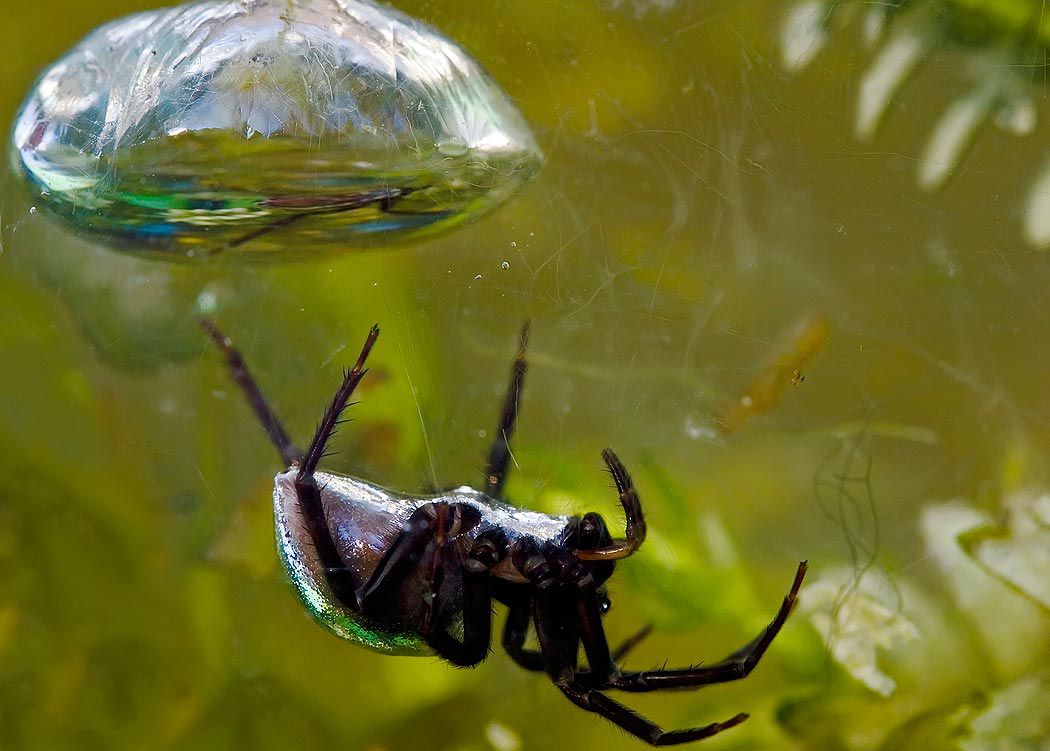

6. Behavior: Diving bell spiders spend most of their time underwater, rarely venturing to the surface. They are excellent swimmers and can move both forwards and backward in the water. When disturbed, they can quickly retreat into their diving bell. 7. Reproduction: Mating in diving bell spiders occurs underwater. After mating, the female lays her eggs inside a silk sac, which she attaches to the vegetation near her diving bell. The female guards the eggs until they hatch, which usually takes several weeks. 8. Lifespan: Diving bell spiders have a relatively short lifespan, typically living for about one year. The offspring of the spider overwinter in their mother's diving bell before emerging in the spring. 9. Conservation Status: The diving bell spider is considered a vulnerable species due to habitat loss and degradation. Pollution and the introduction of non-native species also pose a threat to their populations. 10. Scientific Research: Diving bell spiders have attracted scientific interest due to their unique adaptations and behavior. Researchers study them to understand their ability to live underwater and their potential applications in engineering and biomimicry.
The Black Death
Deadiliest Plague
The bubonic plague, also known as the Black Death, was one of the most devastating pandemics in human history.
1. Historical Background: The bubonic plague first emerged in the 14th century in Central Asia and spread rapidly along trade routes, reaching Europe in 1347. It is believed to have originated from fleas that infested rats. 2. Causal Agent: The bubonic plague is caused by the bac...
